Multiplayer Games Design
I'm building a series of multiplayer games where players connect directly to each other via WebRTC (P2P), without using a server.
WebRTC Multiplayer
Players can start instantly by creating a host and letting others join, or by connecting to a friend’s host—both directly via WebRTC, regardless of distance.
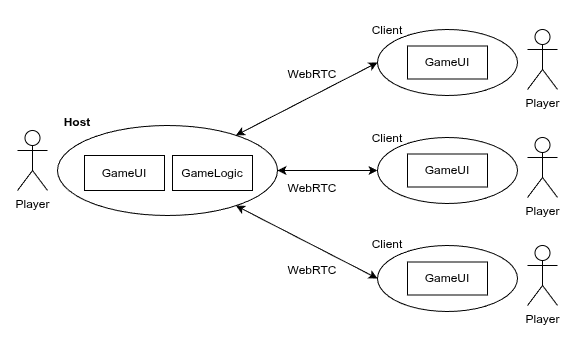
In this setup, one client acts as both the server (or host) and a player. This host is responsible for the entire game state and logic. All other clients connect directly to this host. The host's GameLogic component receives actions from all players (including itself), computes the next game state, and then broadcasts the update to everyone.
The host (server) will have three main components: Network, GameLogic, and GameUI. In contrast, the other clients only need the Network and GameUI components.
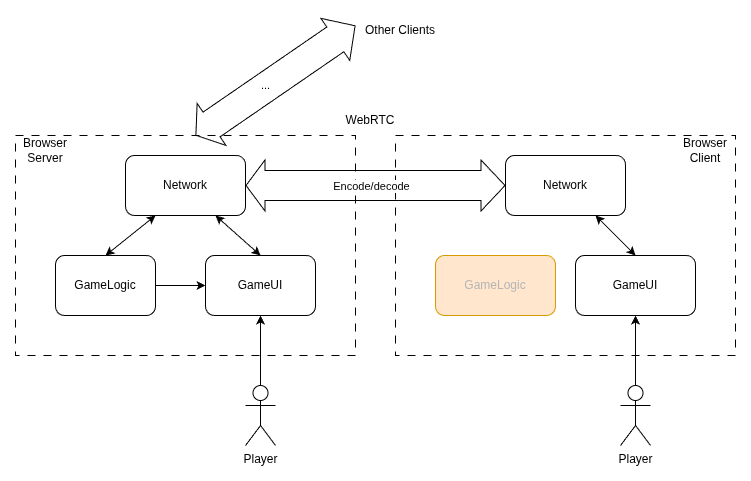
- Network: Sends and receives player actions and game state updates.
- GameLogic (Host-only): Processes incoming actions to compute the next game state.
- GameUI: Renders the current game state and captures player input (actions).
Here are the implementation logic, 1 codebase handle both host and client cases.
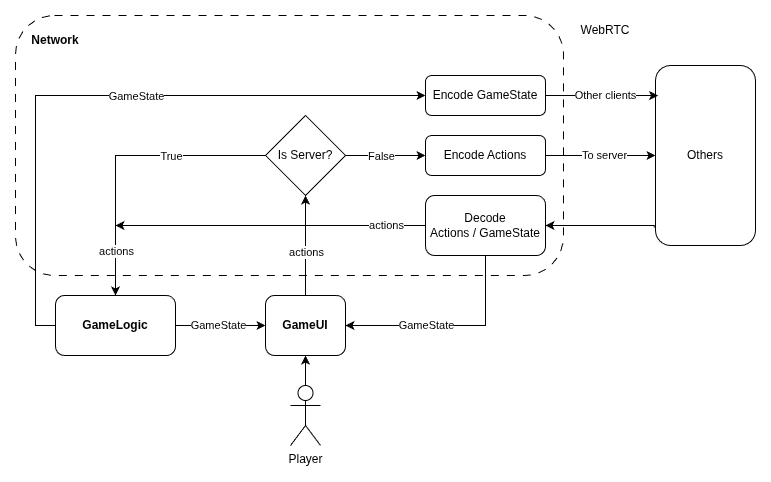
This design applies on the current Bomb game. My next games will follow this closely.
Implementation
Message types from host to client, client to host.
// types.ts
export type GameClientMsg =
  // client to host
  | { type: 'join', pos: { x: number, y: number } }
  | { type: 'action1', dataAction1: {...} }
  | { type: 'action2', dataAction2: {...} }
  // ...

export type GameHostMsg =
  // host to client
  | { type: 'joinedSuccess', id: number }
  | { type: 'update1', dataUpdate1: {...} }
  | { type: 'update2', dataUpdate2: {...} }
  // ...
The key implementation logic here is the Network component. It receives the clientId and functions sendAll(msg), sendTo(clientId, msg) from the WebRTC layer.
GameNetwork
  // Host only
  sendToClients(msg: GameHostMsg) {
    // update the UI itself
    this.gameUI.handleHostMsg(msg)
    // send to other clients
    this.sendAll?.(JSON.stringify(msg))
  }

  // Host only
  sendToClient(clientId: string, msg: GameHostMsg) {
    if (clientId === this.clientId) {
      // send to itself
      this.gameUI.handleHostMsg(msg)
    } else {
      this.sendTo?.(clientId, JSON.stringify(msg))
    }
  }

  // Both host and client
  sendToHost(msg: GameClientMsg) {
    if (this.gameLogic) {
      // host sends to the its GameLogic component
      this.gameLogic.handleClientMsg(this.clientId, msg)
    } else {
      // client sends to host over network
      this.sendTo?.(this.hostId, JSON.stringify(msg))
    }
  }

  // Both host and client
  receiveMsg(fromClientId: string, data: string) {
    if (this.gameLogic) {
      // host receives msg from client
      const msg: GameClientMsg = JSON.parse(data)
      this.gameLogic.handleClientMsg(fromClientId, msg)
    } else {
      // client receives msg from host
      const msg: GameHostMsg = JSON.parse(data)
      this.gameUI.handleHostMsg(msg)
    }
  }
GameLogic
  constructor(private gameNetwork: GameNetwork) {
    // Running gameloop
    setInterval(() => {
      this.update()
    }, GameLoopTime)
  }

  // receive action from a client
  handleClientMsg(clientId: string, msg: GameClientMsg) {
    switch (msg.type) {...}
  }

  // loop update
  private update() {...}
GameUI
  // receive game updates from host
  handleHostMsg(msg: GameHostMsg) {
    switch (msg.type) {...}
  }
We can optimize network usage by encoding structured data into a binary format before sending it, and decoding it after receiving it.
WebRTC Over Central Server
Below are the pros and cons of using WebRTC instead of a central server for multiplayer games.
Pros
- Single codebase: Faster to implement, test, and deploy.
- Decentralized hosting: Anyone can host a game at almost no cost, with virtually unlimited scalability.
- Low latency: Especially fast on the same local network.
- P2P live streaming: Supports streaming gameplay to millions through peer-to-peer connections.
Cons
- Network restrictions: Some networks may block P2P connections.
- Cheating risk: Host may manipulate results or cheat on the leaderboard.
Features
- P2p multiplayers.
- P2p game streaming.
- Record and playback.
- AI integration (TODO):
- Live AI commentator.
- AI create games applying the p2p multiplayers structure.